
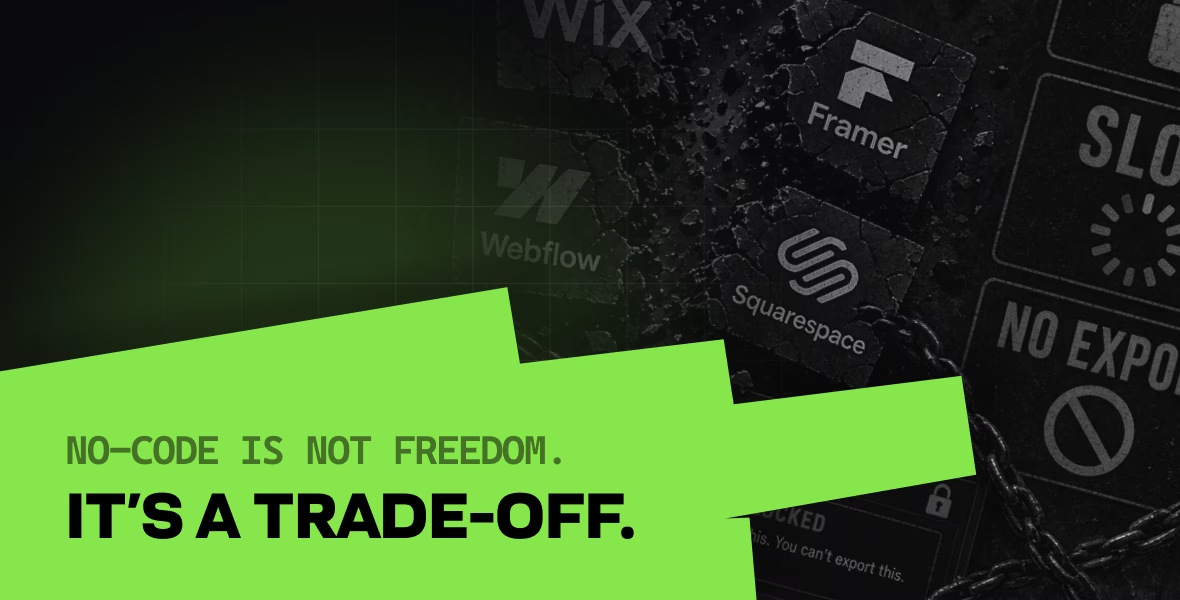
Framer, Wix, Webflow, Squarespace, and the rest of the no-code industry love selling the same dream:
“You don’t need to code. Just drag, drop, and launch.”
It sounds like freedom. But convenience and ownership are not the same thing.
You start with beautiful templates, polished animations, and an editor that makes everything look effortless. Then your project grows, your requirements become more complex, and the limitations start to appear.
Want custom functionality? You may need expensive workarounds, third-party integrations, or features the platform simply doesn’t support.
Want maximum performance? You discover that visual simplicity doesn’t automatically translate into lightweight code, fast loading times, or complete control over what runs on your website.
Want to leave? Your design, content, CMS structure, and integrations may not transfer cleanly to another platform. Exporting some data is not the same as being able to move your entire website without rebuilding it.
And every platform comes with its own trade-offs.
Framer makes it easy to create polished, modern websites, but more complex applications and highly customized workflows can require a different approach.
Wix offers an accessible all-in-one solution, but you trade some architectural freedom for convenience and managed infrastructure.
Webflow provides more visual development control, yet you’re still working within its hosting, CMS, pricing, and export limitations.
Squarespace makes launching a professional-looking website straightforward, but deep customization and portability can become more challenging as requirements evolve.
These platforms are not useless. Far from it.
They’re excellent for landing pages, portfolios, marketing websites, and projects where speed and simplicity matter more than technical independence.
The problem starts when you mistake convenience for control.
The real cost isn’t necessarily the monthly subscription. It’s the potential cost of migrating, rebuilding functionality, working around limitations, or discovering that the platform no longer fits your business.
That’s where WordPress remains a compelling alternative.
You can host it where you choose, access its underlying code, control your database, extend its functionality, and build your own distribution and development workflow. You’re not tied to a single proprietary website builder in the same way.
Of course, WordPress isn’t completely effortless. Hosting, updates, security, performance, and maintenance require attention. Freedom comes with responsibility.
But that responsibility also gives you options.
You can change hosting providers, hire different developers, modify the code, build custom integrations, or redesign your entire architecture without having to abandon the foundation of your website.
That’s a meaningful difference.
Pretty demos sell. Convenience attracts. But ownership gives you options.
If your website is central to your business and needs to evolve over the next five or ten years, don’t choose a platform based solely on how quickly you can launch your first page.
Choose based on what you’ll be able to build, control, and change when your business outgrows the original plan.
Because the best platform isn’t necessarily the one that makes launching easiest.
It’s the one that gives you the right balance of convenience, flexibility, and control for the future you’re building.


Comments
No comments yet — start the conversation.